Your cart
Your cart is empty
Continue shoppingDrawer menu

Gold bracelet designs for women range from fine chains that disappear under a shirt cuff to broad openwork cuffs that carry a whole outfit. That spread is exactly why choosing one feels scattered. A style that suits a wedding saree rarely suits a Monday at a desk.
Three decisions sort out most of it: the construction (chain, cuff, bangle or stone-set line), the gold itself (solid, plated or gold-tone), and the wrist it has to sit on. Get those right and the styling mostly follows.
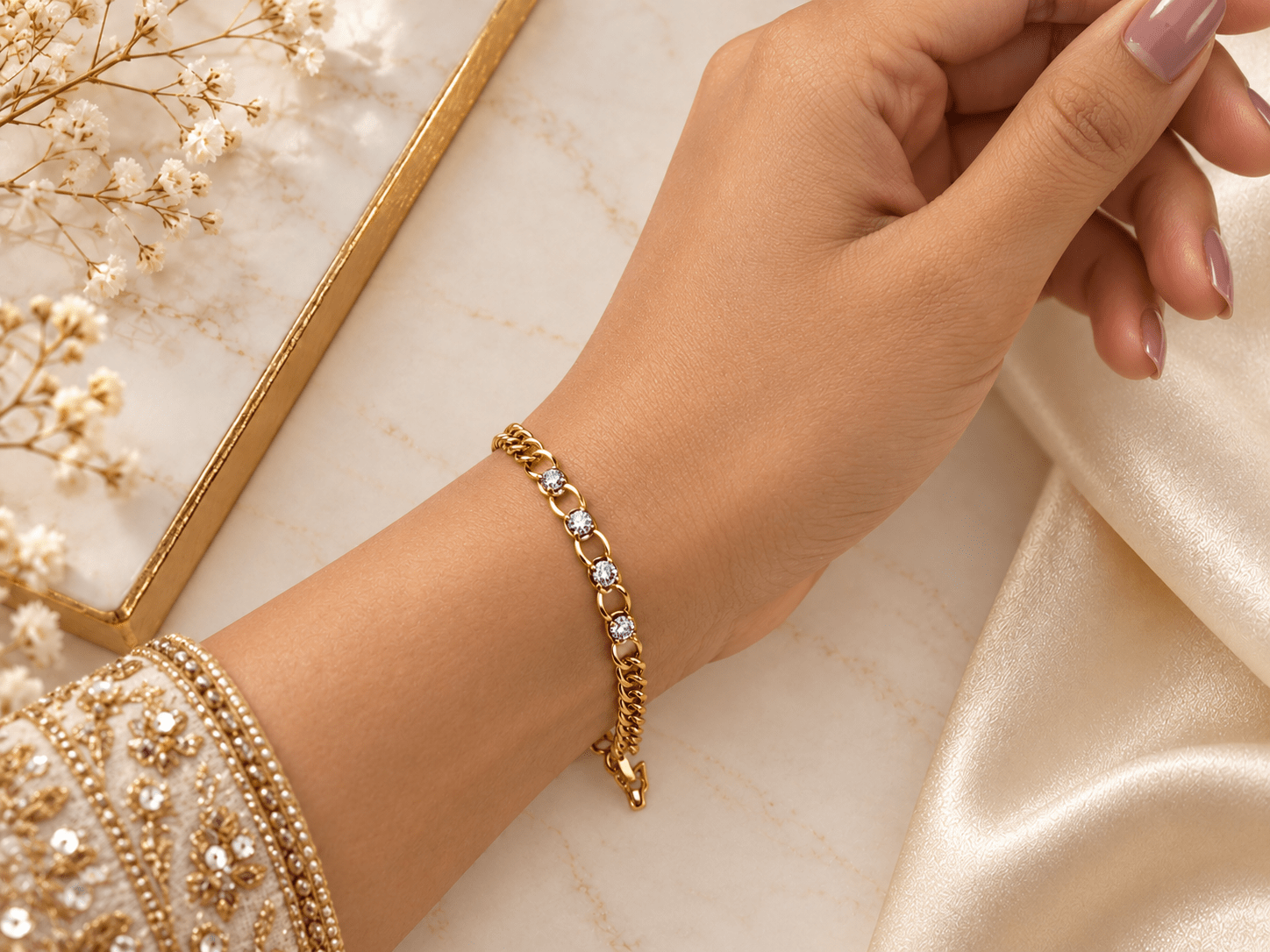
A chain bracelet is the most wearable format. Cable links look neutral and familiar, curb links lie flat and read a little bolder, and box or snake chains give a smooth, almost liquid line.
Paperclip-style links, with elongated ovals, sit between classic and modern. Thin chains layer well. Wide ones usually work best alone.
The clasp matters more than most people expect. A lobster clasp is secure, a spring ring is lighter but smaller, and a box clasp with a safety latch suits heavier chains. A few extra links at the end let one bracelet fit over a watch or without it.
A cuff is an open band that slips onto the wrist from the side. There's no clasp to fumble, and the width gives it presence.
Resizing a cuff by bending it is risky. It can crack the metal or damage the finish, especially on plated or stone-set pieces, so choose the right size at the start.
For a textured gold-tone option, the woven mesh cuff with layered links pairs an open lattice band with a rectangular centre panel of clear stones. Its listing gives the weight as 19.50 g, which is worth weighing up for all-day wear.
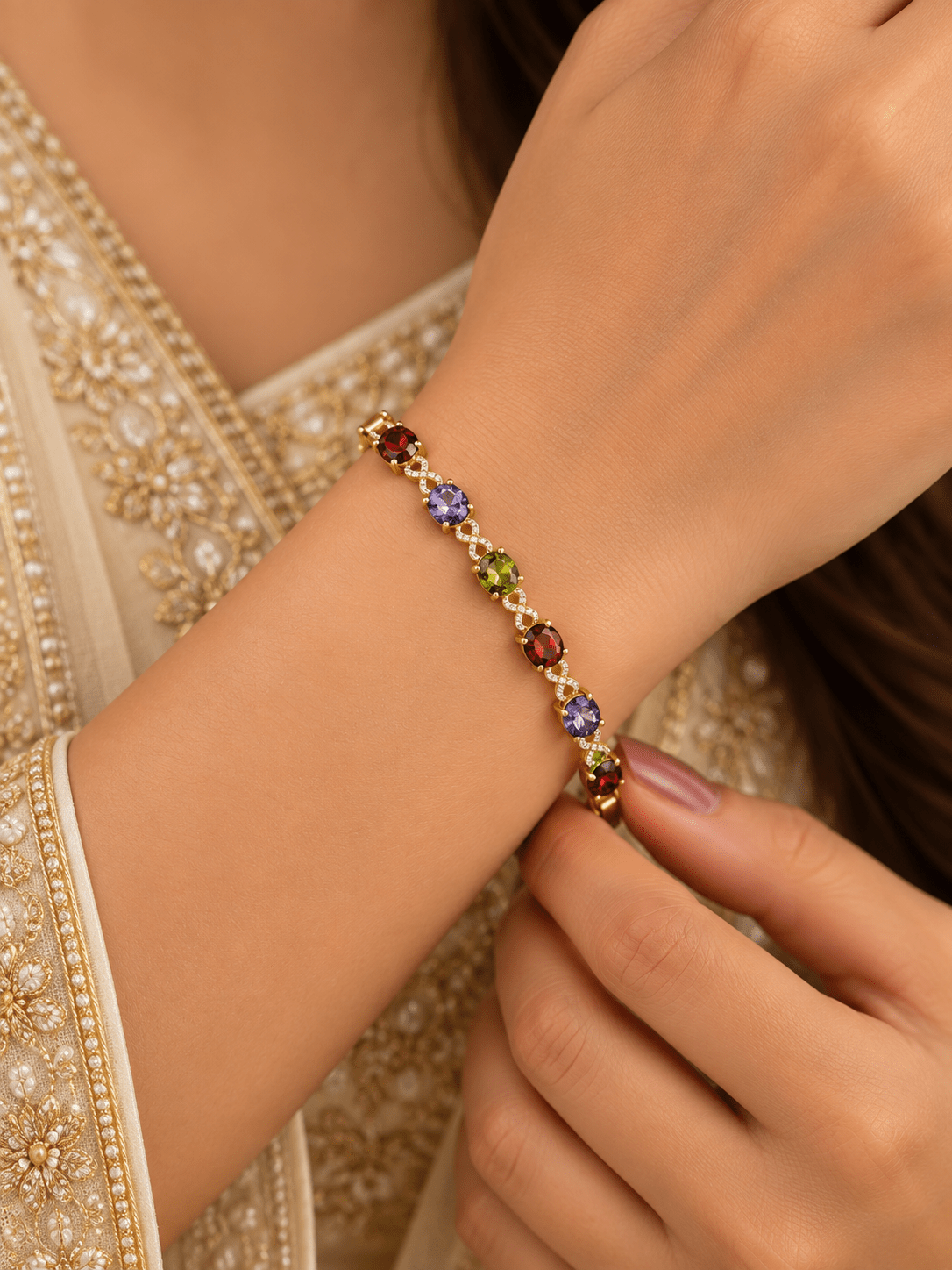
If colour is the point, the emerald swirl cuff adds deep green accents and clear crystal-like stones to gold-tone scrollwork. Both are imitation jewellery, not solid gold.
Rigid circular bracelets are sized differently from chains. What counts is the inner diameter, not the length.
Slim bangles stack easily, while textured ones often look best in a pair. A set of gold-tone bangles with fine linear and geometric detailing suits kurtas, sarees and everyday wear without taking over the wrist.
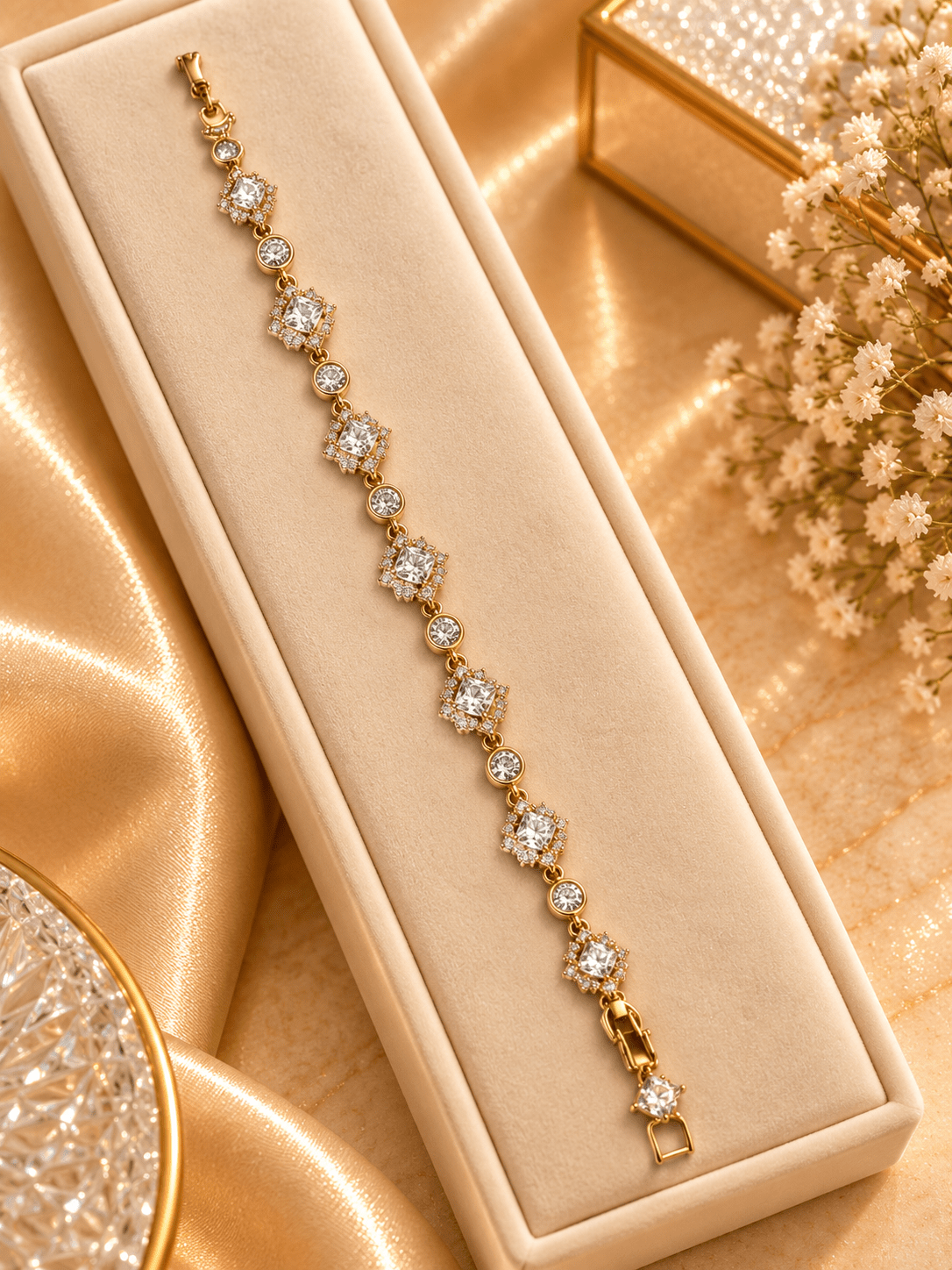
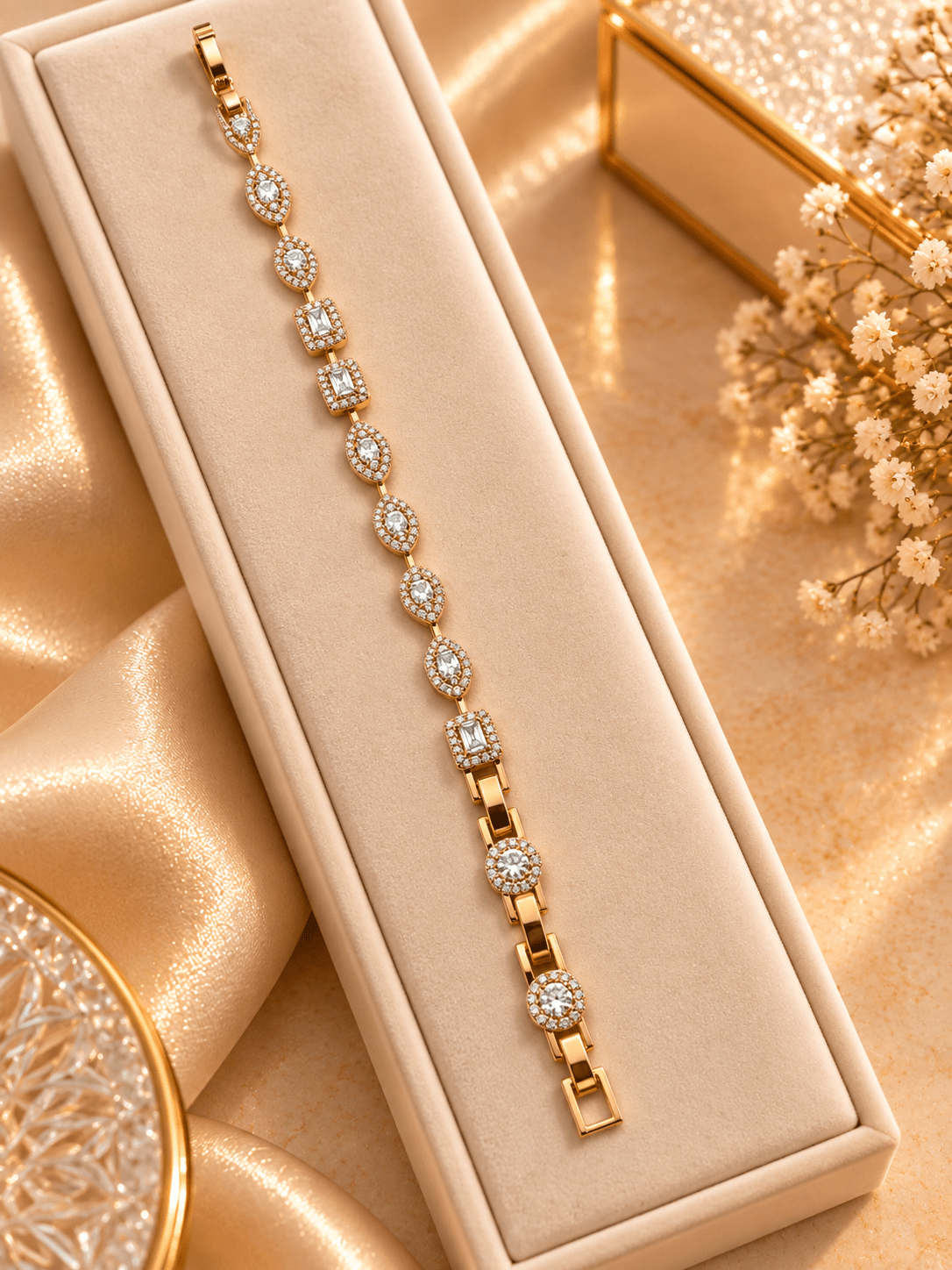
A tennis bracelet is a flexible line of identical stones set in a row. In solid gold with real diamonds, it's a high-value piece. With cubic zirconia or crystals, it belongs to a completely different category and should be described that way.
Mixing gold and silver tones is a practical way to wear one bracelet with both kinds of jewellery. A slim two-tone bracelet set with multistrand lines comes as a coordinated pair, so the stack is already balanced.
Solid gold means the piece is a gold alloy all the way through. Pure 24K gold is soft, so jewellery is usually made in 22K, 18K or 14K. Those contain 91.6, 75 and 58.3 percent gold respectively, with other metals added for strength and colour.
In India, hallmarked gold jewellery carries a BIS mark showing its purity. That mark, along with the karat and weight, is what proves a bracelet is solid gold.
Gold-plated jewellery has a thin layer of gold over a base metal. The layer wears with friction, sweat and chemicals, and its thickness varies from piece to piece.
Gold-tone, gold-finish and gold-coloured describe appearance only. They make no promise about gold content, and they're common terms for imitation jewellery. Anything described this way should never be treated as genuine gold.
One quick test: if a listing never states a karat value, and the price sits far below the day's gold rate for that weight, it isn't solid gold. A bracelet design for women gold in colour may look identical to a solid one in photos, so the material line is what tells them apart.
Newer-looking designs tend to move away from the plain round chain. Open links, woven or mesh textures, mixed gold and silver tones, geometric panels and a single bold stone are all ways a bracelet gets a contemporary feel.
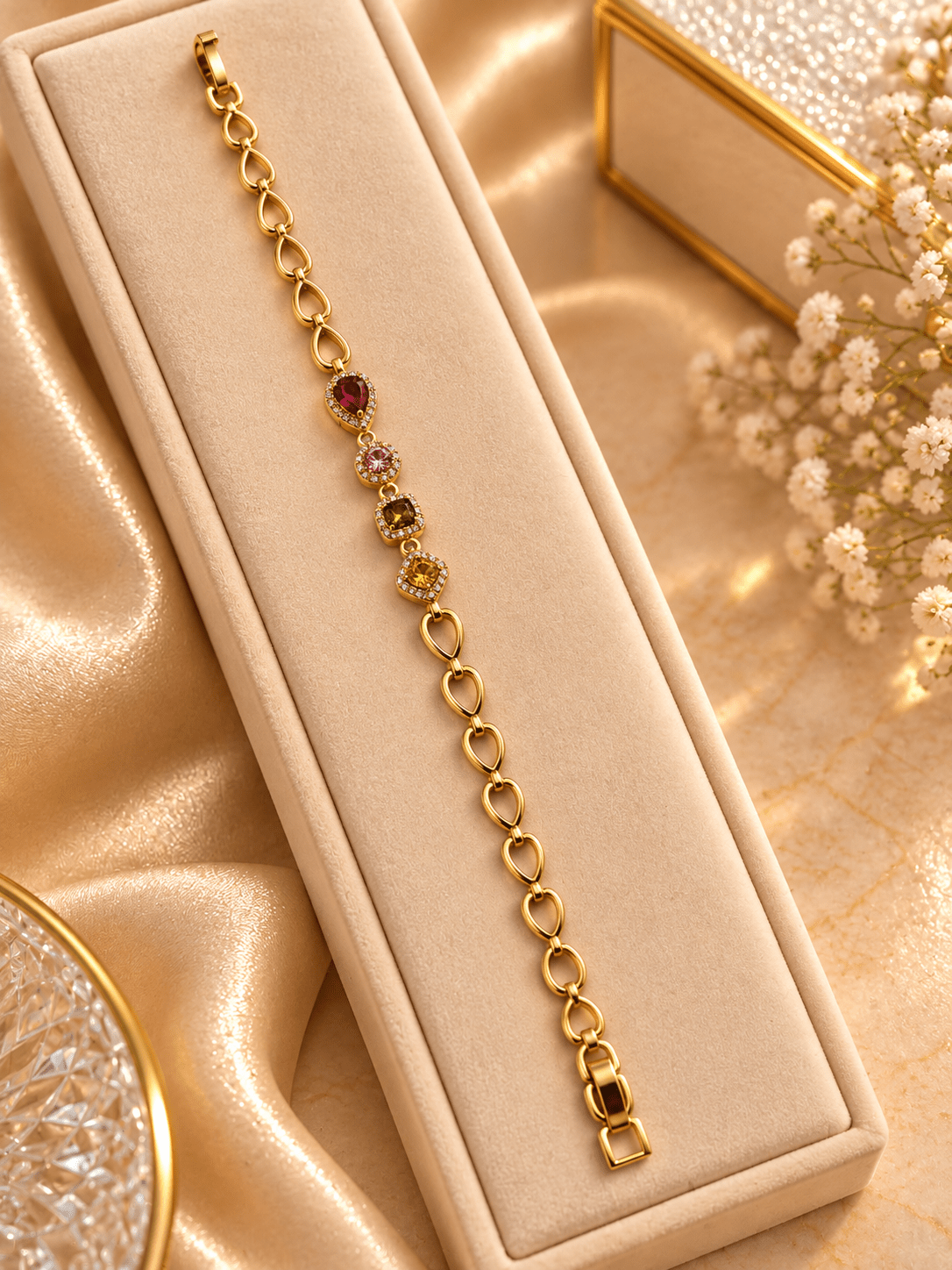
The gold-tone leaf link bracelet with silver-tone detailing shows the openwork route. It uses elongated leaf-shaped links in a repeating pattern, with silver-tone accents inside the links.
Classic shapes still hold their ground. A simple chain or smooth bangle rarely looks out of place, which is why many people start there.
A gold bracelet for women latest design can look striking in photos. The one that actually gets worn is usually the one that fits the wrist and survives a full day of typing, travelling and handshakes.
Start with the day it has to survive. For desk work, a slim chain or smooth bangle with no sharp edges is far easier to live with than a stone-heavy cuff that snags on sleeves and keyboards.
For weddings and festive evenings, go bolder. A cuff or textured bangle in a warm gold tone works well with red, green, maroon and cream, and it can be the only statement piece on the wrist.
A few checks save disappointment:
If you have sensitive skin or a known metal allergy, check the material details for the exact piece before buying, and don't assume a finish is safe because it looks gold.
For chain bracelets, wrap a soft measuring tape or a strip of paper around the wrist just above the wrist bone. Mark where it overlaps, measure it, then add roughly 1 to 2 cm depending on how loose you like it. Many women's chain bracelets fall between about 16 and 19 cm, but the wrist decides.
For bangles and kadas, the bangle has to pass over the widest part of the hand. Tuck the thumb in, press the palm narrow, and measure around the knuckle area. Alternatively, measure the inner diameter of a bangle that already fits well.
Indian bangle sizes are quoted by inner diameter in inches, in steps such as 2.2, 2.4, 2.6 and 2.8. Stacking several bangles needs a little extra room, since slim ones sit tighter together.
For cuffs, check the listed inner circumference and the size of the opening, not just a general "free size" note.
With sarees and lehengas, one detailed cuff or a pair of textured bangles is usually enough. Heavy embroidery and a heavy bracelet compete, so let one of them lead.
For office wear, choose slim chains or smooth bangles that sit quietly beside a watch. If the watch dial is large, keep the bracelet thin.
Western outfits suit a single paperclip chain or a mixed-tone pair. Gold and silver tones together look intentional when both appear elsewhere in the outfit, such as in earrings or a ring.
For evenings, pick one lead piece and keep everything else quieter. A wide cuff with a simple dress needs very little else.
Solid gold can be cleaned with mild soapy water and a soft brush, then dried well. Store it separately, since gold scratches against harder pieces.
Plated and gold-tone bracelets need a gentler routine. Keep them away from water, perfume, deodorant and lotions, and put them on after makeup and fragrance. Wipe with a soft cotton or microfibre cloth after each wear, and store in a dry pouch or airtight box.
Skip abrasive polishes and chemical dips on anything plated. They can strip the finish.
The best gold bracelet designs for women are the ones that match the wrist, the outfit and the material the buyer actually wants. Chains suit everyday wear, cuffs and kadas carry occasions, and two-tone sets add flexibility.
Check whether a piece is solid gold, gold-plated or gold-tone before anything else, measure the wrist properly, and let one bracelet lead the look.
The main types are chain bracelets, cuffs, bangle-style bracelets or kadas, tennis bracelets, and charm or bar styles. Each one differs in weight, flexibility and how it sits with other jewellery.
Look for a stated karat value and a hallmark, and check that the price matches the weight at the current gold rate. Gold-plated pieces have a thin gold layer over base metal. Gold-tone only describes colour.
No. Gold-tone describes how a piece looks, not what it's made of. The material line on the listing is the only reliable guide.
Measure your wrist for chains and add about 1 to 2 cm. For bangles, measure around the widest part of the hand or the inner diameter of one that already fits.
Yes. Keep one of them as the lead piece. A large watch pairs better with a slim bracelet, and a bold cuff works better beside a simple watch. You can also wear them on separate wrists.
A slim chain or smooth bangle is the easiest choice. Low profiles with polished edges and few stones are less likely to snag on sleeves or keyboards.
Wipe them with a soft dry cloth after wearing and store them in a dry pouch. Avoid water, perfume, lotions and abrasive polish, since they can wear the finish down.